- Cable runs longer than 10 metres
- A consumer unit that needs replacing or upgrading first
- Cable that needs burying or routing under a driveway
- Three phase supply work
We tell you all of this at survey, before you commit. Nothing gets added halfway through.
The EV Chargepoint Grant covers a share of the supply and installation cost. It is currently open to:
- People renting their home, in any property type
- Owners of flats and apartments
- Households with on street parking only, using an approved cross pavement solution
- Residential landlords, across multiple properties
There is also a Workplace Charging Scheme for business premises.
Owner occupiers of houses are no longer eligible. That changed several years ago.
The grant is claimed by the installer on your behalf, so it comes off your bill rather than being something you have to apply for yourself. We handle the paperwork.
Grant values and eligibility rules change. We confirm what you qualify for at survey.
For almost every home, 7kW.
A 22kW charger needs a three phase supply, and the overwhelming majority of UK homes are single phase. Upgrading to three phase is expensive and usually involves work from the network operator.
On top of that, many electric cars cannot accept 22kW AC charging anyway. The car's onboard charger caps the speed regardless of what the wall unit can deliver, so you pay for capacity you will never use.
A 7kW unit fully charges any current EV overnight and fits comfortably inside off peak tariff windows. Unless you already have a genuine three phase supply, 7kW is the right answer.
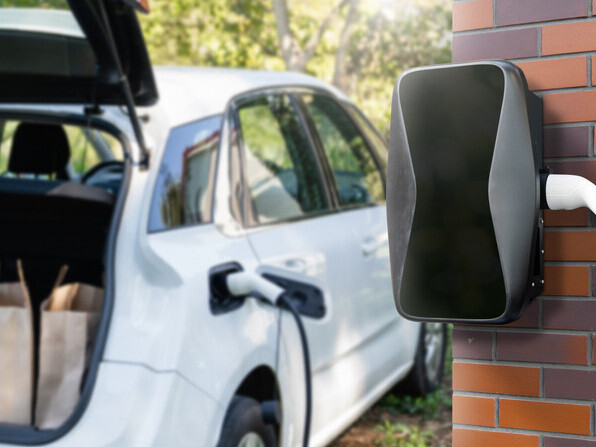
A tethered charger has the cable permanently attached. It is quicker to use day to day, you just unhook and plug in, but you are tied to that connector type and the cable lives outside in all weathers.
An untethered charger has a socket, and you use the cable that came with the car. Tidier, more flexible if you change vehicles or have visitors with a different connector, but it means getting the cable out of the boot every time.
Most people with one car and one driveway prefer tethered. Most people with changing vehicles or shared parking prefer untethered.
EV charging is a continuous high load, not a short burst like a kettle. That changes what the installation has to do.
It needs its own dedicated circuit, not a spur taken off something existing.
It needs specific fault protection under Section 722 of the wiring regulations, which covers electric vehicle charging installations.
Your earthing arrangement has to be assessed. Some supply types require additional protection before an outdoor charger can be fitted at all, and this is the single most common reason an installation is not as simple as it first looks.
All new smart chargers must comply with the Smart Charge Point Regulations.
Get any of that wrong and you have a fire risk on a circuit that runs for eight hours a night, plus an installation that will be flagged the next time the property is inspected.